



The UK CBAM: What it is, how it will affect UK businesses and how to comply
The UK Carbon Border Adjustment Mechanism (CBAM) is a new policy designed to place a carbon price on emissions embedded in certain imported goods. Announced by the UK Government and due to take effect on 1 January 2027, the mechanism aims to prevent carbon leakage and level the playing field between domestic producers (who face UK carbon pricing) and overseas suppliers that produce more emissions-intensive goods without equivalent carbon costs (GOV.UK+1)
Key Facts
- Start date: 1 January 2027.
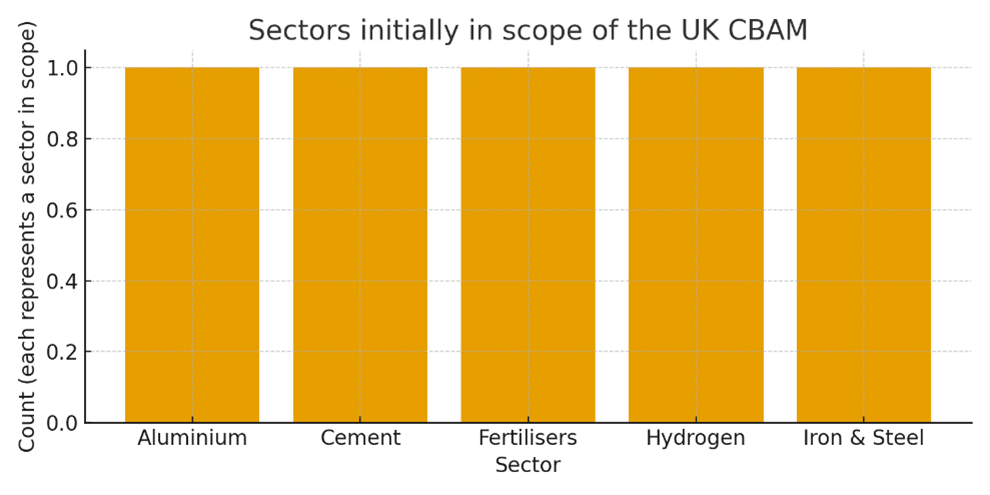
- Sectors initially in scope: Aluminium, Cement, Fertilisers, Hydrogen, Iron & Steel.
- Greenhouse gases covered: CO₂ across sectors; N₂O for fertilisers; PFCs for aluminium. (International Carbon Action Partnership+1)
- Mechanism type: UK CBAM is designed as a tax-based mechanism that charges a carbon price on embodied emissions in imports (the UK’s approach differs from the EU’s market-based CBAM in several respects).
- Calculation principle: The CBAM charge will be calculated by multiplying the embodied emissions of the imported product by a sectoral domestic carbon price published periodically by the UK Treasury; relief is given where an equivalent carbon price has already been paid abroad. (A&O Shearman+1)
Why the UK is introducing CBAM
The government’s stated aim is twofold:
- Prevent carbon leakage – i.e., avoid domestic decarbonisation being undermined because production relocates to countries with weaker climate policies
- Level the playing field – ensure that imports face a carbon price comparable to that faced by UK producers so that UK industry competitiveness isn’t unfairly harmed.
Who will be affected?
- Importers of the goods in-scope (aluminium, cement, fertilisers, hydrogen, iron & steel) will be the primary compliance population. In practice this means businesses that bring these products into the UK supply chain — importers, brokers, or others handling import declarations — will be required to report and pay the CBAM charge unless relief applies.
- Downstream users and distributors could be affected indirectly through higher input costs. Companies in sectors that buy these materials (construction, manufacturing, automotive, chemicals etc.) should assess exposure (One Click LCA+1)
- Foreign exporters will be affected indirectly since UK importers will need evidence of any carbon prices paid abroad (to claim relief).
Reporting Requirements
The draft legislation and government guidance indicate importers will need to:
- Report embodied emissions for goods imported in scope (tonnes CO₂e per consignment/product) — including direct and specified indirect emissions (e.g., electricity used in production where relevant).
- Document any carbon price paid in the country of production (to claim deduction/credit). This requires verifiable evidence from the exporter or producer.
- Submit periodic returns to the administering body (HMRC is expected to administer and collect the CBAM charge) and pay the calculated CBAM tax. The government response and draft legislation describe administrative and reporting arrangements to be finalised in secondary legislation and guidance.
- Retain records — importers should expect obligations to retain documentation supporting emissions calculations, supplier evidence, and payments (similar to customs/tax record-keeping).
Timing & Frequency
Draft material indicates the CBAM charge will be published and applied at intervals (the Treasury will publish the sectoral domestic carbon price on a quarterly basis), and reporting/payment cadence will be set out in the final rules and guidance before 2027. Importers should prepare now for quarterly reporting rhythms and likely monthly/quarterly returns. (A&O Shearman+1)
How the charge is calculated (high-level)
- Calculate embodied emissions of the imported good (CO₂e). That includes direct emissions from production and, where specified, indirect emissions such as electricity used in the manufacturing process.
- Multiply the embodied emissions (tonnes CO₂e) by the sectoral domestic carbon price published by the Treasury for that period. This gives a CBAM charge in GBP. (A&O Shearman)
- Deduct any carbon price already paid by the producer/exporter (supported by verifiable documentation) to avoid double charging.
Note: the exact detailed rules for scope of emissions (which indirect emissions are included), permitted evidence of carbon prices paid abroad, and the method for assigning emissions to specific shipments will be set out in primary/secondary legislation and guidance. Businesses should follow updates closely as draft legislation is finalised.
Practical steps UK businesses should take now to ensure compliance
Even though the detailed secondary rules are still being finalised, businesses should begin preparatory work now. Practical steps include:
- Assess exposure — identify whether you import in-scope goods (aluminium, cement, fertilisers, hydrogen, iron & steel) or have supply chains that depend on these materials. Quantify volumes and supplier origins.
- Map upstream emissions — ask suppliers to provide robust emissions data for each product (CO₂e per tonne or per unit). Where suppliers cannot provide data, consider requesting verified life-cycle or production-emissions data. (International Carbon Action Partnership+1)
- Gather evidence of any carbon pricing paid abroad — request documentation from foreign suppliers showing any carbon price, tax, or ETS payments they have made, to support deductions. Ensure documents are auditable.
- Upgrade systems and controls — ensure your ERP, procurement, and customs systems can capture and report emissions data, supplier declarations, and CBAM-relevant documents. Expect to integrate carbon data into import declarations or CBAM returns. (Deloitte)
- Allocate responsibilities — decide who in your organisation (tax team, customs, procurement, sustainability/ESG) will manage CBAM reporting and payments. Establish internal controls and audit trails. (Mayer Brown)
- Engage suppliers early — especially where suppliers are in jurisdictions without robust carbon pricing, you may need additional audits, supplier questionnaires, or third-party verification. (One Click LCA)
- Financial planning — model the potential CBAM cost per product and scenario-test procurement choices (e.g., switching suppliers, negotiating costs, or passing costs downstream). (A&O Shearman)
- Monitor government guidance and industry guidance — the government will publish detailed guidance and draft legislation is open to technical consultation; engage in industry groups and monitor HMRC/Treasury publications.
Final notes
The primary legislation and secondary instruments are still being finalised; while the broad design is clear (start date, sectors, calculation principle), the detailed reporting forms, precise timelines for returns, record-retention periods and evidentiary standards will be set out in the final legislation and administrative guidance. Businesses should treat the information above as guidance based on draft legislation and government publications and prepare accordingly. (GOV.UK+1)
For your free CBAM Reporting & Record-Keeping Checklist, email solutions@imsolutions.info today.